Tips On How To Handle Mother’s Day

Dear Motherless Daughter,

You’re probably not looking forward to Mother’s Day this year—or any year. I’ve been motherless since I was eight and I still don’t look forward to Mother’s Day. Even when my children were young and celebrated me with handmade cards and burnt toast, I still felt sad that I wasn’t able to personally celebrate with my mom. 

When I was a kid, my dad and I planted window boxes for my mother on Mother’s Day. The colorful boxes sat under the two windows at the front of our modest, post-war bungalow in Nebraska. Flowers have always reminded me of my mother—from the pink carnations on her casket to the bachelor buttons and multi-colored zinnias she planted in our backyard.

I’ve had seventy-one Mother’s Days to learn how to survive the day in the healthiest way possible. Here are a few tips I’ve learned along the way:

* Plan ahead for how you’ll spend the day. My husband and I will take a local dinner cruise on Mother’s Day (I live in Florida). Balmy weather, beautiful scenery, the movement of the boat, and someone besides me preparing lunch, all make for a lovely day and takes my mind off the sadness.

* Do something to honor your mother. In my gardening days, I frequently planted a rose bush or other long-lasting, flowering plant. These days, I buy “us” a bouquet of pink carnations.

* Acknowledge your sad feelings. If you’re new to loss, use Mother’s Day as a time to tell your mother-story to a trusted friend or share your sad feelings with someone you love. If this isn’t possible, journal about your feelings. Be honest when someone asks, “How are you?” 

* Stay away from triggers. It’s hard to avoid the hype for Mother’s Day—ads for gifts, card displays, social media posts of happy mothers and daughters. Don’t fixate on them. Move along. You can be glad for those who are celebrating without immersing yourself in situations that tap into your sadness or anger. 

* Celebrate the mothers in your family. Even if it’s a difficult day for me, I’m thankful that my children didn’t grow up motherless. My mother also grew up without a mother (her’s died when she was three), so I’m particularly grateful to have broken the cycle of loss.

* Stop anticipating disaster. Sometimes the anticipation of Mother’s Day is worse than the actual day. That’s how “COVID-Christmas” was for me. Anticipating the holiday away from family was terrible; the actual day—not so bad. The lesson? Tell yourself it’s just another day—one day out of 365. Don’t succumb to the “ain’t it awful” syndrome. 

Thinking of you—Mershon
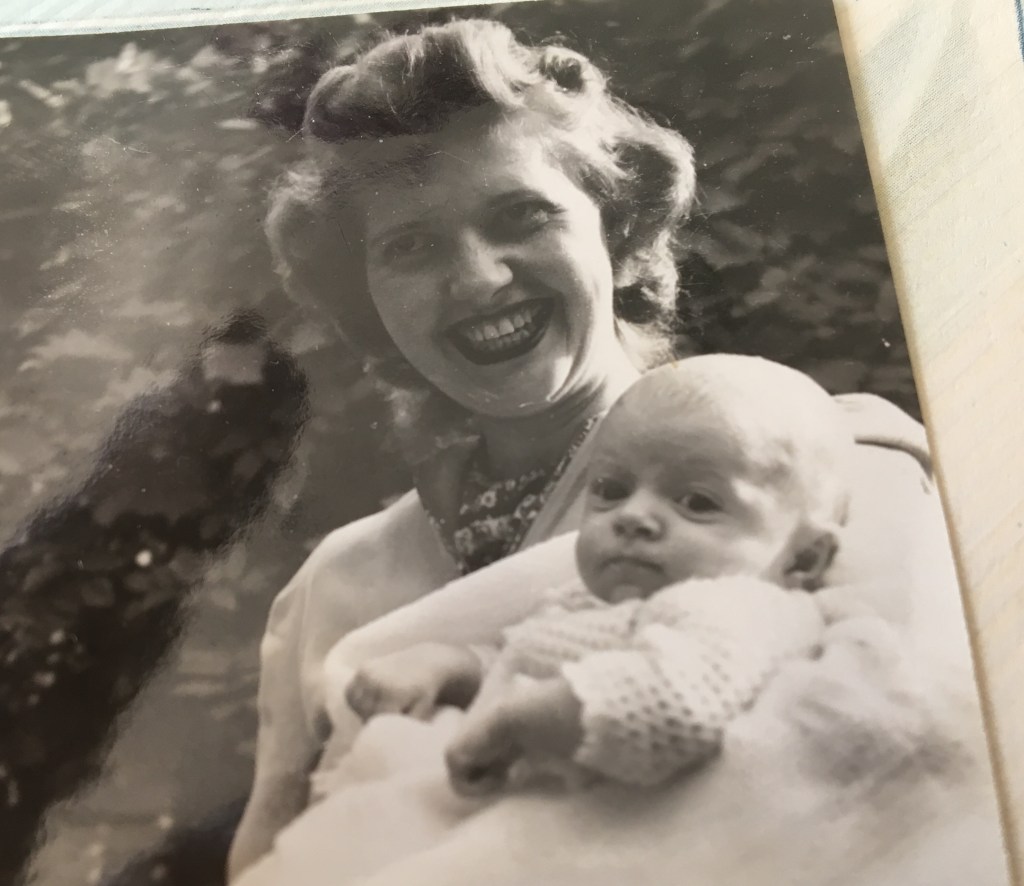
My Mom and I in 1945.

Are You Willing To Share Your Story?

The willingness to share our story signals a desire to leave a legacy and to turn pain into a message of hope for others. Mershon Niesner, author

I was recently a guest of Motherless Daughters Ministry for a live zoom interview/podcast. One of the topics we discussed was the importance of telling our stories as motherless daughters. 

Why is storytelling important? As stated above, sharing our story can turn pain into a message of hope but it also allows us to keep our memories alive for a lifetime. 

Also, if your story is a secret, overtime the secret itself can do more psychological damage than the event. 

Affirmation: When appropriate, I will share my mother loss story.

Coaching questions: If you’ve never shared your full story or haven’t shared it in many years, with whom might you confide? What difference do you think sharing your story will make in your life and in the life of the person with whom you’re sharing? 

Photo by Trung Thanh on Unsplash

No Regrets

I don’t regret what I’ve been through. I’ve had ups and downs, super highs and some really low lows. I’ve been so blessed that I could never say, ‘I wish this didn’t happen.’ It’s part of who I am. Jennifer Lopez, entertainer

If a genie suddenly appeared in your life, what would you wish for? Like Lopez, I wouldn’t change much. The highs and lows of my life molded me into the less-than-perfect, 79-year old woman I am today.

If you’ve recently experienced loss, however, my guess is you would wish it away. But the inevitable can’t be wished away forever. Even though we wish that our loved ones could have stayed with us longer, all living things come to an end. 

Given the chance, I’d wish for world peace, the eradication of cancer, Alzheimer’s and other horrible diseases, and I’m not too crazy about hurricanes. But I choose not to wish my life away. How about you?

Affirmation: I have no regrets.

Coaching questions: If you had three wishes, what would they be? How have you been changed by the ups and downs of your life? What will help you be content with where you are in your life right now?

Photo by Dayne Topkin on Unsplash

The Flower of Mother’s Day

Symbols are the imaginative signposts of life. Margot Asquith, author

Pink carnations have always been special to me because they were the flowers on my mother’s casket and one of the few memories I have of the months following her death seventy years ago.

 I thought they were randomly chosen by my dad but, perhaps, he chose them for their meaning. “Light pink carnations represent love and gratitude that are similar to a Mother.” They also say, “I’ll never forget you.”

In America, they are the official Mother’s Day flower. 

Affirmation: I honor the symbols in my life.

Coaching questions: What symbols do you hold dear? What do they mean to you and why? How do they help you keep your memories alive?

Photo by Sixteen Miles Out on Unsplash

Listen To Master Yoda!

Fear is the path to the dark side. Fear leads to anger. Anger leads to hate. Hate leads to suffering. Master Yoda

If you are a person who has experienced tragic mother loss especially early loss, abandonment, or murder, you’ve probably experienced fear at some level. Fear for your survival, fear of the future, fear of losing another parent, and/or fear of abandonment. 

It’s only when we overcome our fears and, perhaps, our anger and hate, that we can truly flourish and live our best life. There has been enough suffering, let’s not inflict it upon ourselves by embracing our fears. Let’s move away from the dark side. 

Affirmation: I’m fearless.

Coaching questions: What fears do you have that need releasing? Be specific and name two. What is one step you can take to move away from this dark side of living?

Photo by Emmanuel Denier on Unsplash

Never Take Away HOPE

Blogger’s note: I posted this blog three years ago but, since I still have such strong feelings about the topic, I’m reposing. Blessings!

Character cannot be developed in ease and quiet. Only through experience of trail and suffering can the soul be strengthened, ambition inspired, and success achieved. Helen Keller

It breaks my heart to read the posts of women in motherless daughters’ groups telling a woman who is in despair over having just lost her mother that “it doesn’t get any better.” I shout out at my computer screen, “For Heaven’s sake, give the poor grieving woman some hope!” Most of us, if we’re over thirty, have suffered at least one significant loss. If all of us never recovered from loss, we would all be walking around like the Zombies we were the first week.

Even Helen Keller, with no sight, hearing or voice, offered a message of hope for those who are suffering and in distress. I believe it’s important to acknowledge a person’s grief, be with her in the reality of the moment, offer no platitudes like “she’s better off now” or “you’ll be fine.” Saying nothing is always good. Your presence is what matters. Reminisce with her about her loved one. But please, please, don’t take away hope for her future. Hope may be the only thread attaching her to this Earth—sometimes, literally.

Affirmation: I will be a healer and do no harm.  

Coaching questions: What helped you most in times of despair? What words or presence brought you the most comfort? How do you show up for your friends and family in times of distress?

Photo by Ronak Valobobhai on Unsplash

Learning To Live With Loss

What we have once enjoyed we can never lose; all that we deeply love becomes a part of us. Helen Keller

(This is a repurposed blog from a few years ago but I thought the message important enough to repeat.)

Loss of a loved one is always difficult. It’s the price we pay for having a great love. However, we can be joyful again as we learn to accommodate to life after loss.

C.S. Lewis in A Grief Observed likened accepting your life after loss to a man learning to walk after a leg has been amputated. Lewis writes, “The amputee may get along quite well, may even become facile and agile on crutches or on a carefully designed artificial limb. But the amputee must accommodate to permanent loss. He or she will never walk as before; repair does not mean a return to the way things were.”

Our life will never be as it was before our loss but those we love are always a part of us. 

Affirmation: I can learn to be joyful again after loss.

Coaching questions: How are you different after loss? In what ways have you accommodated to your loss? What will you do next? 

Take a Moment to Share Your Story

We are lonesome animals. We spend all of our life trying to be less lonesome. One of our ancient methods is to tell a story begging the listener to say—and to feel—‘Yes, that is the way it is, or at least that is the way I feel.’  You’re not as alone as you thought. —John Steinbeck, author

Not only does sharing important stories from our past help us feel less lonesome, as Steinbeck says, it also helps us move forward after challenging life events. As a friend listens, nods, understands, or personally relates to our story, we feel validated. We begin to understand how our experience is not only meaningful to us but also to another person. 

In addition to sharing with trusted indivIduals, invite storytelling into your groups. Use a “Getting to Know You” question or share a story related to the topic at hand. This can happen in book clubs, Bible studies, planning committees, wherever caring people congregate. Tell your stories and invite others to do the same. 

Affirmation: I benefit from telling my story.

Coaching questions: To whom can you tell your mother loss story? What difference will it make?

Photo by Abo Ngalonkulu on Unsplash 

Reframing our stories

Reframing is a term from cognitive psychotherapy which simply means seeing something in a new way, in a new context, with a new frame around it. Elaine Aron, author

At a recent, online, author event, I spoke with a woman who had lost her mother as a child. Now, in mid-life, she’s losing her precious step-mother to Alzheimer’s. 

She and her sister are devastated by the prospect of losing two, beloved mothers. Their attitude, however, is keeping them positive and strong. She said, “We tell each other how lucky we’ve been to have two mothers who loved us so much. Our sadness comes from an abundance of love.”

Affirmation: I will reframe my life experiences. 

Coaching question: What message do you need to reframe? 

No Matter Your Circumstances, You Have Choices

Meaning and purpose can come from deep in the heart of what hurts us the most. Dr. Edith Eva Eger, Auschwitz survivor and author of The Choice

Dr. Eger’s book, The Choice, is one of the most powerful books I’ve read this year. It is her Auschwitz story and much, much more. It’s how she learned to move forward and find meaning and purpose in her life by choosing to heal as she embraced her feelings, then acknowledged and forgave her past. 

Her message of CHOICE is addressed to all of us who have experienced loss—loss of freedom, loss of a loved one, and even, the loss of our humanity. As a psychotherapist and author, Eger’s passion is to help people who have experienced loss move forward with their lives in a positive way as they find meaning and purpose in their pain. Eger writes, “How easily the life we didn’t live becomes the only life we prize.” 

Affirmation: I choose to embrace the life I have. 

Coaching questions: What helped you find meaning and purpose “in the heart of what hurt you”? If you’re stuck in thinking that the life you were denied is the only one you prize, what will help you move forward?