The Gift of Generosity

True generosity is an offering; given freely and out of pure love. No strings attached. No expectations. Time and love are the most valuable possessions you can share. Suze Roman, author, financial advisor

’Tis the season of giving. There are “duty gifts” and “love gifts.” We give both. The greatest gifts are those given freely with no attachment. No expectations. As Suze says, true generosity is an offering. I take this to mean offering as in the biblical sense, a sacrifice. 

Humans are inherently insecure creatures. The accumulation of things offers us a sense of security. This is why giving generously out of love gives us such a feeling of satisfaction and joy. In addition to all those duty gifts you’re buying, consider giving at least one love gift with no strings attached. Spent your money, your time, or use your talents—all are gifts. 

Affirmation: I give out of love.

Coaching questions: What’s the best gift you’ve ever received? What’s the best gift you’ve ever given? What gift of love will you give this season?

IMG_2694.jpg

Using Creativity to Help Heal Your Broken Heart

Experiencing overwhelming pain doesn’t mean you shouldn’t try to sketch new thoughts or paint new memories. Pain can be as transformative as the art on a torn canvas. Jess, blogger Visit her blog at https://outoftheashes33.wordpress.com

After suffering the loss of her sister and mother, Jess started writing about her personal journey. She writes on her blog, “I found my voice, I found my truth, but most importantly, I found healing in the words that were flowing from my soul.”

Whether we write, paint, make cards, cook, refinish furniture, garden—creativity seems to be one part of the process to heal our broken hearts. In my book Mom’s Gone, Now What?, creativity claims a chapter as one answer the Now What? question. Jess has found relieve and the beginnings of recovery through her writing. She writes from raw feelings and the deep emotion of a broken heart that is healing.

Affirmation: I can use creativity to heal.

Coaching questions: What’s a creativity endeavor you enjoy? How might you use it in your healing process? 

IMG_2474

Exchanging Perfection for Good-Enough

More smiling, less worrying. More compassion, less judgment. More blessed, less stressed. More love, less hate. Roy T Bennett, author

Are you striving to replicate the perceived “perfect” Christmas of your childhood for your grand children? Perhaps you want to impress your in-laws or not be judged by them. Maybe good-enough just doesn’t measure up to your personal desire to control the situation and make everything exactly right. 

It’s that time of the month to ask yourself, “What can I let go of?” Do I really have to make Aunt Susie’s rum balls? Who will I disappoint if I don’t? Accept the reality of not pleasing everyone so you can take care of yourself during this busy time. Loosen your attachment to an idealized past and create a good-enough holiday. Yourself will thank you and so will your children or grandchildren when you’re present for them and not a stress-out mess!

Affirmation: I can accept good-enough.

Coaching questions: If you’re stressed out right now, consider what you might delete from your activities, menu, gift-giving. What does a good-enough holiday look like?

Ask Yourself These Three Questions

We know so many things but we don’t know ourselves. Go into your own ground and learn to know yourself there.  Meister Eckhart, German theologian

Naikan is a Japanese word meaning “inside looking” or “introspection.” Naikan, used as a method of self-reflection, was developed by Japanese Buddhist, Yoshioto Ishin. The Naikan approach broadens our view of reality and helps us heal the past. Naikan reflection is based on three questions:

What have I received from __________?

What have I given to ____________?

What troubles and difficulties have I caused __________?

These questions will help you reflect on your relationships and see them from all sides. They can be helpful in the process of forgiveness, understanding, and a reality check on your own behavior.

Affirmation: I’m willing to look inside.

Coaching question/request: Take 20 minutes and reflect on these questions. Consider using them as prompts in a daily meditation. What difference might the answers make in your life?

Discovering the Heart of Change

Conversation is the currency of change. Margaret Wheatley, American author

In a time when there is great division in our country and around the world, conversation is paramount. Change happens when “the other” has a name, a face, and is willing to honestly share his or her views. You may still have differing opinions. However, when there is conversation, there is the possibility of relationship, understanding, and change.

It’s comforting to gather with like-minded friends and colleagues. It’s a growth opportunity to expose oneself to diverse ideas, cultures, ages, life-styles. 

Affirmation: I want to be in conversation.

Coaching questions: In the past, what conversations have helped you change and grow? What conversation do you need to have today?

Remembering Pearl Harbor

Remember Pearl Harbor, never again. The Pearl Harbor motto.

On the morning of  December 7, 1941 there was a surprise military attack on Pearl Harbor, a U.S. naval base in Hawaii. The battle was the tipping factor that convinced the United States to enter into World War II.

As we come together in remembrance, we celebrate the ultimate triumph of the human spirit. However, no matter the result, war is always brutal and ugly. My dad,(shown here,  hated all war. Besides WWII, he also served in the Korean conflict and spent his civilian career working in a Veterans’ Hospital. He witnessed the human devastation of war first hand. I pray that as we honor those who have lost their lives defending our freedom, we learn from our past. If only the motto were true—never again.

Affirmation: I remember.

Coaching questions: How do you connect to this day in history? What contribution can you make to “never again?”

IMG_2157.jpg

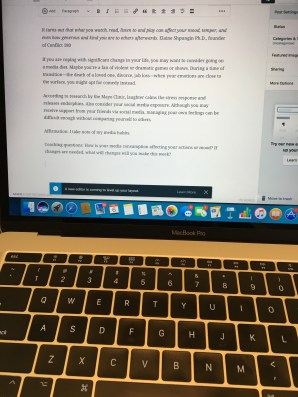
Consider Going On a Media Diet

It turns out what you watch, read, listen to and play can affect your mood, temper, and even how generous and kind you are to others afterwards. Elaine Shpungin Ph.D., founder of Conflict 180 

If you are coping with significant change in your life, you may want to consider going on a media diet. Maybe you’re a fan of violent or dramatic games or shows. During a time of transition—the death of a loved one, divorce, job loss—when your emotions are close to the surface, you might opt for comedy instead. 

According to research by the Mayo Clinic, laughter calms the stress response and releases endorphins. Also consider your social media exposure. Although you may receive support from your friends via social media, managing your own feelings can be difficult enough without comparing yourself to others.

Affirmation: I take note of my media habits.

Coaching questions: How is your media consumption affecting your actions or mood? If changes are needed, what steps will you take this week?

IMG_2691.jpg

Is It a Wonderful Time of Year?

The purpose of life is not to be happy. It is to be useful, to be honorable, to be compassionate, to have it make some difference that you have lived and lived well. Ralph Waldo Emerson, American essayist

“It’s the most wonderful time of the year,” the song says. But that’s not true for everyone. For some, it’s the most difficult time of the year. Too much loneliness, too little money, too much stress, too little love. Maybe this is true for you. If it truly is a wonderful time of the year for you, what can you do to make it better for someone else? 

Sometimes a visit, a listening ear, a bright smile can make a difference to someone who is feeling low. Be mindful of those around you.

Affirmation: I can make a difference.

Coaching questions: What’s something you can do make the holidays better for someone who is having a difficult time? What can you do for yourself if you are in need? How can you ask for help?

IMG_3014

It’s All About Ability

The human spirit is one of ability, perseverance, and courage that no disability can steal away. 

Yesterday was the International Day of Persons with Disabilities. A day to promote understanding and to support the dignity, rights and well-being of people with disabilities. I like the positive terms, differently-able or mobility challenged. 

My best friend is wheel-chair bound and is one of the most joyful, fulfilled people I know. She is eighty-three, lives alone in the country, is involved in her church and community, and has a long-list of family and friends who love being around her. Her mobility is challenged but her life is all about ability—-sociability, lovability, faith ability. She is my inspiration.

Affirmation: I am not defined by what I can’t do.

Coaching questions: How do you perceive those who are mentally or physically challenged? What can you do to promote understanding and support for people who are differently-able? 

IMG_2690.jpg

Telling the Hard Truths

Better the hard truth, I say, than the comforting fantasy. Carl Sagan, American astronomer

I recently had the opportunity to talk with a honest, straight forward, 60-something daughter whose mother has dementia.  She said her mother is belligerent, sharp-tongued, even mean at times. I asked her if this behavior is the result of the dementia. “No,” she replied, “she’s always been like that.”

Not all mothers, dead or alive, were/are sweet, loving, caring people. It is just fantasy, as Sagan says, to believe so. Sometimes when people die they become “saints” in our memories. Hiding or denying real experiences and feelings slows recovery and keeps us from being our authentic selves.

Affirmation: I am a gentle truth teller.

Coaching questions: Is there some truth telling you need to do about someone in your life?  How can you move towards being truthful with yourself?